





Headline 1 of 5
Latest news
 AIOpenAI essay rejects expectation that humans will cede authority to AIAn unnamed author writing for OpenAI rejected the silent consensus, the expectation that humans could lose authority over world affairs to machines. The author argued that cumulative delegation to artificial intelligence could weaken human primacy even without a machine rebellion. The essay proposes accountability and limits on automated systems as a starting point, not a complete blueprint.
 AIOpenAI says its models improved AMD GPU design metrics by up to 14%OpenAI said its models found up to 14% improvement in power, performance and area (PPA) against heavily optimized baselines for AMD’s flagship GPU intellectual property. OpenAI said AMD included some model-generated changes in a design sent for manufacturing and added others to production design files for future versions. In tests on two open-source processor cores, GPT‑6.2 Astra had the highest average score on both; the reported gains concern design evaluations and circuit changes, not a measured speed increase in finished AMD chips.
 AIOpenAI reports increased researcher use of coding agentsOpenAI reported increased researcher use of coding agents, with median daily use valued at about $2,400 per researcher at API list prices. For the four weeks ending October 18, logged experiments per active experimenter averaged 1.68 times the 2025 baseline. OpenAI said the measurements are partial and do not establish that more research activity means faster progress.
 AIOpenAI explains Codex sandbox controls and Windows shift to MXCOpenAI explained how Codex runs commands in users’ existing environments under filesystem and network restrictions. Its built-in :workspace profile allows writes in the workspace and broad reads subject to operating-system permissions, but disables network access by default. OpenAI said it is replacing its existing Windows sandbox with one based on MXC for compatible devices; users and administrators can configure permissions, while MCP server launch commands are not sandboxed automatically.
 AIGemini app expands to eligible Android Go devicesGoogle announced that Gemini is coming to eligible Android (Go edition) devices, expanding access to the app. Google says it re-architected Gemini to run on lower-memory devices and that Gemini Live supports more than 45 languages. Users can download Gemini from Google Play, access it through supported phones, or find it preloaded on some upcoming partner devices.
 AIGoogle begins rolling out expanded Project Genie to eligible AI Ultra subscribersGoogle has started rolling out an expanded Project Genie experience to eligible Google AI Ultra subscribers, including first-time access to Genie 4, upgrades to Genie 3, a creation agent and a community gallery. Genie 4 supports in-session world edits and adaptive real-time audio, while Genie 3 sessions can run for up to 3 minutes per generation and support panorama-based worlds and linked journeys. Google says Project Genie-generated video and audio carry SynthID watermarks and that model inputs and outputs undergo safety screening; both models remain in frontier research, with technical challenges still being addressed.
 AIGoogle makes Gemini 4 Neon available for complex workGoogle introduced Gemini 4 Neon on Nov. 18, 2026, for complex software engineering, knowledge work and science workflows. Google reported a score of 61 and a third-place overall ranking on the Artificial Analysis Intelligence Index at the model’s xhigh thinking level, alongside a second-place ranking on the Vals Index. The model has a 1 million-token context window and is available to specified developer, business and subscriber audiences, while cyber-focused access for trusted defenders is expected through the Fairwind Program in the coming days.
 AICloudflare open-sources Kitesurf browser engine for AI agentsCloudflare has made Kitesurf available as open-source software on GitHub under the Apache 2.0 license. The experimental browser engine for AI agents runs on Cloudflare Workers and supports the Chrome DevTools Protocol (CDP), which lets compatible tools connect to it. Developers can run Kitesurf locally or deploy it to their own Cloudflare Workers accounts; deployment requires a Workers Paid plan.
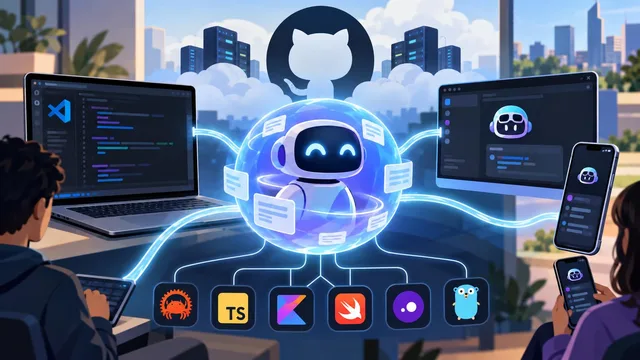 AIGitHub and VS Code make open protocol for continuing agent sessions availableGitHub and VS Code say the open Agent Host Protocol (AHP) now supports agent-session continuity across VS Code, the GitHub Copilot app and cloud sandboxes. AHP organizes functions into URI-identified channels, with servers determining session state and clients sending actions. The protocol is available for developers to build on, with libraries in six languages: Rust, TypeScript, Kotlin, Swift, .NET and Go.
 AICloudflare releases updated Clairic and 9-billion-parameter Clairic-flashCloudflare’s Workers AI team has released an updated Clairic and the new Clairic-flash as open-weight extraction models on Workers AI. Cloudflare says the models can process up to four images or PDF pages in one request and reports 576 of 576 synthetic receipt fields extracted correctly in its internal evaluation. Both models are available now on Workers AI and Hugging Face; promotional pricing for Clairic ends on December 1, 2026.